Free safety observation and incident report template
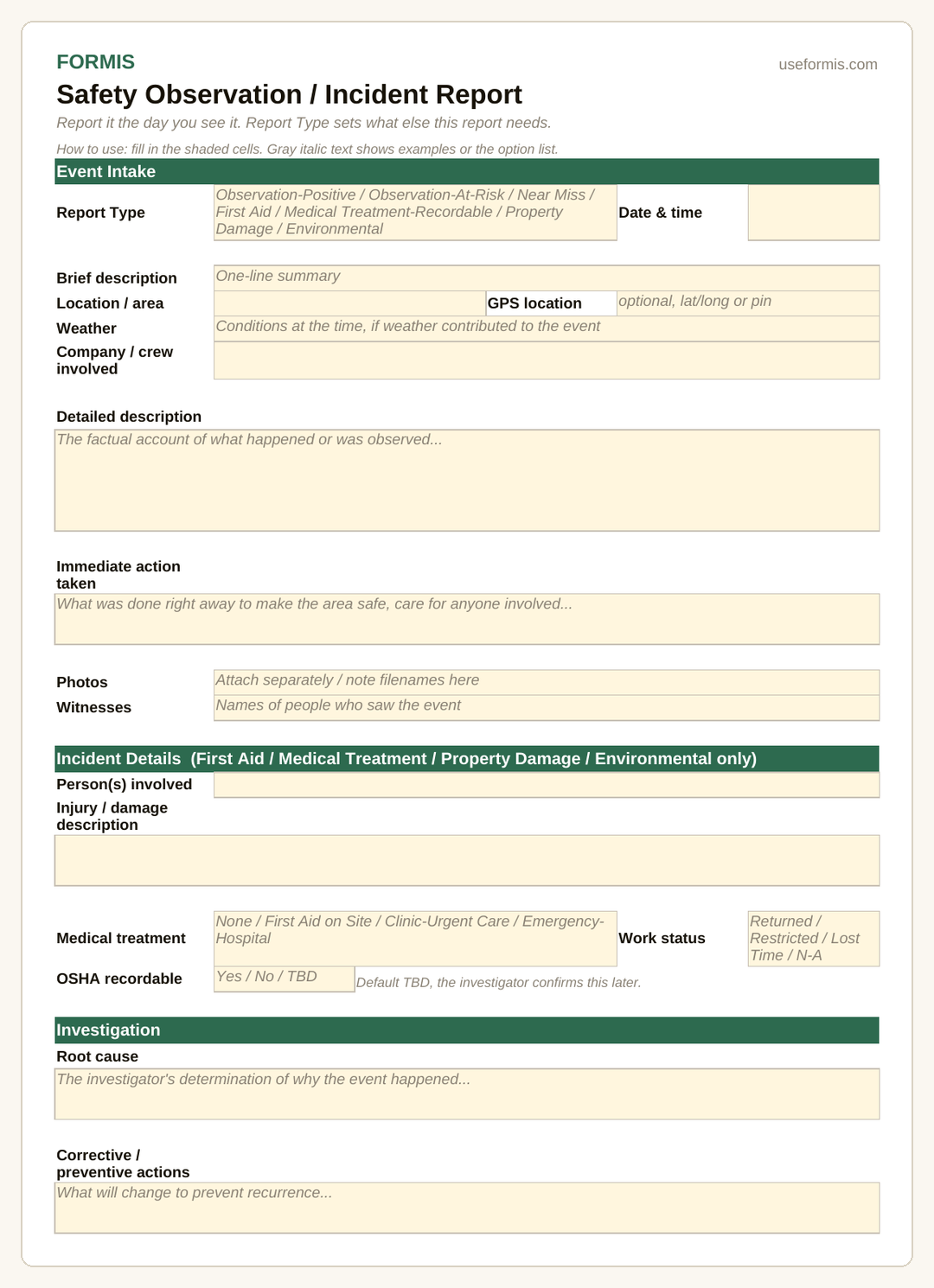
Report type sets what the rest of the report needs, so a quick observation stays quick, and a real incident gets the detail OSHA expects. Download the Excel or PDF version below, no email required.
Observation or incident, and why the type matters
There are two classes of report: proactive (a positive observation, an at-risk condition, a near miss) and incident-class (first aid, recordable medical treatment, property damage, environmental). The type you pick decides how much detail the report actually needs.
Incident-class reports need more than observations do: who was involved, the medical treatment level, work status afterward, returned to work, restricted, or lost time, are the OSHA-significant outcomes, and a call on OSHA recordability, which is fine to leave as to be determined at the time of the report. The investigator confirms it later.
Root cause and corrective action matter beyond the paperwork. They are what actually stops the same thing from happening twice, and what shows a real investigation happened if anyone ever asks. Log weather and location when they are relevant, a footing on wet ground reads differently than the same footing dry.
Runs live in Formis
This exact report runs live in Formis, and the form adapts to what you pick. Choose an incident-class report type and the incident detail fields, medical treatment, work status, OSHA recordability, show up automatically; a routine observation stays short. Weather and GPS can pull in automatically instead of typed by hand. Every report lands in one place, tied to the project, not scattered across paper forms and phone photos.
What is the difference between a near miss and an incident?
A near miss is an event that could have caused injury or damage but did not. An incident, first aid, recordable medical treatment, property damage, or environmental, means something actually happened. Both are worth logging; incidents require more detail and often an OSHA recordability determination.
What should you do immediately after a safety incident?
Make the area safe, get anyone involved appropriate care, and document what happened while it is fresh: location, people involved, and a factual description. Root cause and corrective action typically follow as part of a fuller investigation.
Do you have to report every OSHA-recordable incident right away?
OSHA recordability is often not obvious in the moment, which is why it is fine to mark it "to be determined" on the initial report. What matters immediately is documenting the facts; the recordability determination and any required reporting timelines follow from there. Confirm your specific obligations with your safety officer or OSHA guidance.